Media Summary: For more information about Stanford's online Artificial Intelligence programs visit: This Blog Link: Check out our FREE Courses at ... For more information about Stanford's Artificial Intelligence professional and graduate programs, visit:

Computer Vision Lecture 9 2 - Detailed Analysis & Overview

For more information about Stanford's online Artificial Intelligence programs visit: This Blog Link: Check out our FREE Courses at ... For more information about Stanford's Artificial Intelligence professional and graduate programs, visit: So cornets are currently probably the most frequently used formalism in

Photo Gallery

3D Computer Vision | Lecture 9 (Part 2): Three-view geometry from points and/or lines
Stanford CS231N Deep Learning for Computer Vision| Spring 2025 | Lecture 14: Generative Models 2
Computer Vision - Lecture 2.1 (Image Formation: Primitives and Transformations)
2D Convolution Explained: Fundamental Operation in Computer Vision
3D Computer Vision | Lecture 9 (Part 1): Three-view geometry from points and/or lines
CAP5415 Lecture 9 [Introduction to Convolution Neural Networks - Part II] - Fall2021
3D Computer Vision | Lecture 7 (Part 2): The fundamental and essential matrices
3D Computer Vision | Lecture 9 (Part 4): Three-view geometry from points and/or lines
3D Computer Vision | Lecture 10 (Part 2): Structure-from-Motion (SfM) and bundle adjustment
3D Computer Vision | Lecture 9 (Part 3): Three-view geometry from points and/or lines
Stanford CS230 | Autumn 2025 | Lecture 9: Career Advice in AI
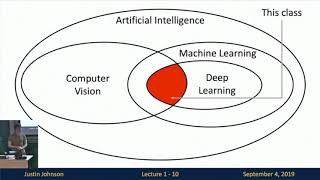
Lecture 1: Introduction to Deep Learning for Computer Vision
View Detailed Profile
3D Computer Vision | Lecture 9 (Part 2): Three-view geometry from points and/or lines

3D Computer Vision | Lecture 9 (Part 2): Three-view geometry from points and/or lines

Here's the video

Stanford CS231N Deep Learning for Computer Vision| Spring 2025 | Lecture 14: Generative Models 2

Stanford CS231N Deep Learning for Computer Vision| Spring 2025 | Lecture 14: Generative Models 2

For more information about Stanford's online Artificial Intelligence programs visit: https://stanford.io/ai This

Computer Vision - Lecture 2.1 (Image Formation: Primitives and Transformations)

Computer Vision - Lecture 2.1 (Image Formation: Primitives and Transformations)

Lecture

2D Convolution Explained: Fundamental Operation in Computer Vision

2D Convolution Explained: Fundamental Operation in Computer Vision

Blog Link: https://learnopencv.com/understanding-convolutional-neural-networks-cnn/ Check out our FREE Courses at ...

3D Computer Vision | Lecture 9 (Part 1): Three-view geometry from points and/or lines

3D Computer Vision | Lecture 9 (Part 1): Three-view geometry from points and/or lines

Here's the video

CAP5415 Lecture 9 [Introduction to Convolution Neural Networks - Part II] - Fall2021

CAP5415 Lecture 9 [Introduction to Convolution Neural Networks - Part II] - Fall2021

CAP5415

3D Computer Vision | Lecture 7 (Part 2): The fundamental and essential matrices

3D Computer Vision | Lecture 7 (Part 2): The fundamental and essential matrices

Here's the video

3D Computer Vision | Lecture 9 (Part 4): Three-view geometry from points and/or lines

3D Computer Vision | Lecture 9 (Part 4): Three-view geometry from points and/or lines

Here's the video

3D Computer Vision | Lecture 10 (Part 2): Structure-from-Motion (SfM) and bundle adjustment

3D Computer Vision | Lecture 10 (Part 2): Structure-from-Motion (SfM) and bundle adjustment

Here's the video

3D Computer Vision | Lecture 9 (Part 3): Three-view geometry from points and/or lines

3D Computer Vision | Lecture 9 (Part 3): Three-view geometry from points and/or lines

Here's the video

Stanford CS230 | Autumn 2025 | Lecture 9: Career Advice in AI

Stanford CS230 | Autumn 2025 | Lecture 9: Career Advice in AI

For more information about Stanford's Artificial Intelligence professional and graduate programs, visit: https://stanford.io/ai ...

Lecture 1: Introduction to Deep Learning for Computer Vision

Lecture 1: Introduction to Deep Learning for Computer Vision

Lecture

F18 Lecture 9: Convolutional Neural Networks (Part 2)

F18 Lecture 9: Convolutional Neural Networks (Part 2)

So cornets are currently probably the most frequently used formalism in