Media Summary: There are a number of properties that might be possessed by a relation on a set including reflexivity, symmetry, and transitivity. Introduction to the Euclidean Algorithm and how it is used to find the greatest common divisor. Video Chapters: Introduction 0:00 ... Exploring what a sequence is, in addition to learning the Arithmetic and Geometric sequences. Video Chapters: Introduction 0:00 ...

Discrete Math 4 3 2 - Detailed Analysis & Overview

There are a number of properties that might be possessed by a relation on a set including reflexivity, symmetry, and transitivity. Introduction to the Euclidean Algorithm and how it is used to find the greatest common divisor. Video Chapters: Introduction 0:00 ... Exploring what a sequence is, in addition to learning the Arithmetic and Geometric sequences. Video Chapters: Introduction 0:00 ... Ceiling function, floor function and factorial function. Video Chapters: Introduction 0:00 Floor and Ceiling Functions 0:13 Factorial ... Here is a quick tutorial on two different truth tables. If there's anyone wondering about the "IF/THEN" statements (the one way ... Writing the sum of a sequence using sigma notation and evaluating the sum. Video Chapters: Introduction 0:00 Sigma Notation ...

Introduction to modular arithmetic including several proofs of theorems along with some computation. Video Chapters: ...
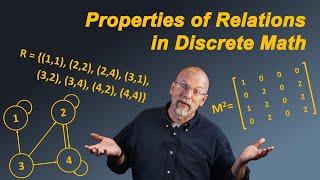
Photo Gallery

Properties of Relations in Discrete Math (Reflexive, Symmetric, Transitive, and Equivalence)
Induction Proof: 2^n is greater than n^3 | Discrete Math Exercises
Discrete Math - 4.3.3 The Euclidean Algorithm
Discrete Math - 2.4.1 Introduction to Sequences
Discrete Math - 2.3.4 Useful Functions to Know
Truth Table Tutorial - Discrete Mathematics Logic
Discrete Math - 4.2.4 Algorithms for Integer Operations
Discrete Math - 2.4.3 Summations and Sigma Notation
MATHEMATICAL INDUCTION - DISCRETE MATHEMATICS
Discrete Math - 4.1.2 Modular Arithmetic
View Detailed Profile
Properties of Relations in Discrete Math (Reflexive, Symmetric, Transitive, and Equivalence)

Properties of Relations in Discrete Math (Reflexive, Symmetric, Transitive, and Equivalence)

There are a number of properties that might be possessed by a relation on a set including reflexivity, symmetry, and transitivity.

Induction Proof: 2^n is greater than n^3 | Discrete Math Exercises

Induction Proof: 2^n is greater than n^3 | Discrete Math Exercises

We prove

Discrete Math - 4.3.3 The Euclidean Algorithm

Discrete Math - 4.3.3 The Euclidean Algorithm

Introduction to the Euclidean Algorithm and how it is used to find the greatest common divisor. Video Chapters: Introduction 0:00 ...

Discrete Math - 2.4.1 Introduction to Sequences

Discrete Math - 2.4.1 Introduction to Sequences

Exploring what a sequence is, in addition to learning the Arithmetic and Geometric sequences. Video Chapters: Introduction 0:00 ...

Discrete Math - 2.3.4 Useful Functions to Know

Discrete Math - 2.3.4 Useful Functions to Know

Ceiling function, floor function and factorial function. Video Chapters: Introduction 0:00 Floor and Ceiling Functions 0:13 Factorial ...

Truth Table Tutorial - Discrete Mathematics Logic

Truth Table Tutorial - Discrete Mathematics Logic

Here is a quick tutorial on two different truth tables. If there's anyone wondering about the "IF/THEN" statements (the one way ...

Discrete Math - 4.2.4 Algorithms for Integer Operations

Discrete Math - 4.2.4 Algorithms for Integer Operations

Several examples of algorithms

Discrete Math - 2.4.3 Summations and Sigma Notation

Discrete Math - 2.4.3 Summations and Sigma Notation

Writing the sum of a sequence using sigma notation and evaluating the sum. Video Chapters: Introduction 0:00 Sigma Notation ...

MATHEMATICAL INDUCTION - DISCRETE MATHEMATICS

MATHEMATICAL INDUCTION - DISCRETE MATHEMATICS

We introduce

Discrete Math - 4.1.2 Modular Arithmetic

Discrete Math - 4.1.2 Modular Arithmetic

Introduction to modular arithmetic including several proofs of theorems along with some computation. Video Chapters: ...