Media Summary: In this video, we will take a look at the complement rule, which is not taught in your textbook directly, but is important, nonetheless. In this video, we will explore the Pigeonhole Principle, which is a topic we didn't touch on in In this video we will take a look at developing the concept of combinations and how they are related to permutations. Again ...

Discrete Math Ii 6 2 - Detailed Analysis & Overview

In this video, we will take a look at the complement rule, which is not taught in your textbook directly, but is important, nonetheless. In this video, we will explore the Pigeonhole Principle, which is a topic we didn't touch on in In this video we will take a look at developing the concept of combinations and how they are related to permutations. Again ... We continue our study of enumeration by examining permutations with objects that are identical. The most common example is in ... We start with a quick review of the linear equation model learned in section 6.5 (see video 6.5.1 for a review). We already know ... In this video we will take a look at developing the concept of permutations. It is important to note that instead of giving you 100 ...

Practice questions for computing the number of ways an outcome can occur. This includes questions involving the sum rule, ... There are a number of properties that might be possessed by a relation on a set including reflexivity, symmetry, and transitivity. In this section, we focus on the application of weighted graphs and how to minimize the distance, time or cost of our graph based ... We further develop the concept of the binomial theorem by looking both at Pascal's triangle and the identity associated with the ...

Photo Gallery

Discrete Math II - 6.1.2 The Complement Rule and Complex Counting Problems
Discrete Math II - 6.2.1 The Pigeonhole Principle
Discrete Math II - 6.3.2 Combinations
Discrete Math II - 6.5.2 Permutations with Indistinguishable Objects
Discrete Math II - 8.6.2 Apply the Principle of Inclusion-Exclusion: Linear Equation Model
Discrete Math II - 6.3.1 Permutations
Discrete Math - 6.3.2 Counting Rules Practice
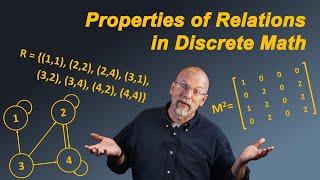
Properties of Relations in Discrete Math (Reflexive, Symmetric, Transitive, and Equivalence)
WGU Discrete Math 2 Tips and Tricks | Passed on 1st Attempt!
Discrete Math II - 10.6.1 Shortest Path Problems - Dijkstra's Algorithm
Wgu - C960 Discrete Math II
Discrete Math II - 6.4.2 Pascal's Identity and Triangle
View Detailed Profile
Discrete Math II - 6.1.2 The Complement Rule and Complex Counting Problems

Discrete Math II - 6.1.2 The Complement Rule and Complex Counting Problems

In this video, we will take a look at the complement rule, which is not taught in your textbook directly, but is important, nonetheless.

Discrete Math II - 6.2.1 The Pigeonhole Principle

Discrete Math II - 6.2.1 The Pigeonhole Principle

In this video, we will explore the Pigeonhole Principle, which is a topic we didn't touch on in

Discrete Math II - 6.3.2 Combinations

Discrete Math II - 6.3.2 Combinations

In this video we will take a look at developing the concept of combinations and how they are related to permutations. Again ...

Discrete Math II - 6.5.2 Permutations with Indistinguishable Objects

Discrete Math II - 6.5.2 Permutations with Indistinguishable Objects

We continue our study of enumeration by examining permutations with objects that are identical. The most common example is in ...

Discrete Math II - 8.6.2 Apply the Principle of Inclusion-Exclusion: Linear Equation Model

Discrete Math II - 8.6.2 Apply the Principle of Inclusion-Exclusion: Linear Equation Model

We start with a quick review of the linear equation model learned in section 6.5 (see video 6.5.1 for a review). We already know ...

Discrete Math II - 6.3.1 Permutations

Discrete Math II - 6.3.1 Permutations

In this video we will take a look at developing the concept of permutations. It is important to note that instead of giving you 100 ...

Discrete Math - 6.3.2 Counting Rules Practice

Discrete Math - 6.3.2 Counting Rules Practice

Practice questions for computing the number of ways an outcome can occur. This includes questions involving the sum rule, ...

Properties of Relations in Discrete Math (Reflexive, Symmetric, Transitive, and Equivalence)

Properties of Relations in Discrete Math (Reflexive, Symmetric, Transitive, and Equivalence)

There are a number of properties that might be possessed by a relation on a set including reflexivity, symmetry, and transitivity.

WGU Discrete Math 2 Tips and Tricks | Passed on 1st Attempt!

WGU Discrete Math 2 Tips and Tricks | Passed on 1st Attempt!

I recently finished

Discrete Math II - 10.6.1 Shortest Path Problems - Dijkstra's Algorithm

Discrete Math II - 10.6.1 Shortest Path Problems - Dijkstra's Algorithm

In this section, we focus on the application of weighted graphs and how to minimize the distance, time or cost of our graph based ...

Wgu - C960 Discrete Math II

Wgu - C960 Discrete Math II

Today I outline how I passed

Discrete Math II - 6.4.2 Pascal's Identity and Triangle

Discrete Math II - 6.4.2 Pascal's Identity and Triangle

We further develop the concept of the binomial theorem by looking both at Pascal's triangle and the identity associated with the ...